
Large tree removal is one of those jobs that looks deceptively simple from the street. A crew arrives with ropes, saws, a bucket truck, and a chipper. A few hours later, a tree that towered over the house is gone. What most homeowners do not see is the amount of planning, structural judgment, and hazard control behind every cut.
That matters in a place like Metairie. Mature live oaks, pines, water oaks, and ornamental species often grow close to homes, fences, driveways, sidewalks, utility lines, and drainage paths. Many lots are compact. Soil can stay wet. Storms are part of life. When a large tree declines, leans, cracks, uproots, or simply outgrows its location, removal becomes less about cutting wood and more about managing risk.
Professionals approach tree removal metairie jobs with a mindset that is closer to controlled dismantling than rough clearing. They read the tree first, then the site, then the weather, then the equipment options. The actual cutting comes later.
Why large trees require a different approach
A small ornamental tree in an open yard can often be removed with straightforward felling techniques. A large tree near a home is different. Weight distribution changes from one limb to the next. Internal decay can hide behind sound bark. A trunk may appear solid and still fail unexpectedly under load. What looks like a modest side lean at ground level can translate into several feet of movement high in the canopy.
The scale alone changes the stakes. A limb over a roof may weigh hundreds of pounds. A trunk section from a mature oak can weigh far more than most people expect, even when cut into short pieces. Add in swing, rope tension, and the rebound that occurs when wood fibers release, and you have forces that can crack a driveway, rip gutters off a house, or injure a worker in seconds.
Metairie adds some familiar local complications. Trees often share tight spaces with service drops, neighboring properties, detached garages, pools, and decorative landscaping that homeowners want preserved. After extended rain, saturated ground can limit where heavy equipment can safely travel. In storm season, there is also pressure to move quickly, and quick decisions are exactly where mistakes tend to happen.
The first step is not cutting, it is assessment
Experienced crews spend meaningful time looking before they touch a saw. That initial assessment shapes everything that follows, from where trucks park to whether the tree comes down in ten pieces or fifty.
They start with the tree itself. Species matters because different woods behave differently. Live oak tends to be dense and strong, which is helpful in rigging but demanding in terms of weight. Pine can be tall and straightforward in one setting, but brittle dead tops and hidden rot can make a pine removal unpredictable. Water oaks often develop structural issues with age. Crepe myrtles can have tangled, multi stem growth that complicates removal near roofs and windows.
Condition matters even more than species. Pros look for cavities, fungal growth, cracks at unions, bark separation, dead leaders, root plate movement, and signs that the tree has already begun to fail. A tree with a hollow trunk may not support a climber safely. A tree that suffered storm damage may hold pieces under tension, ready to spring once cut. One of the most dangerous situations is a tree that looks stable enough to climb but has compromised wood at exactly the wrong anchor point.
Then they assess the drop zone and surrounding exposure. Is there a clean path to lower sections? Are there utility lines nearby? Can brush be dragged out without crossing fragile hardscape? Does the property offer enough space for a crane, or will every piece need to be rigged and hand directed? There is no universal playbook because every yard creates its own limits.
Planning the removal around the property
Homeowners usually focus on the tree. Professionals focus on the relationship between the tree and everything around it.
On a residential lot in Metairie, that often means the work plan is dictated by structures, not by the tree’s shape. A removal over a roof may require branch by branch dismantling, with each piece tied off, cut, swung clear, and lowered under control. A tree over a fence line may require redirecting rigging so sections move inward instead of out toward a neighbor’s yard. If there is a narrow side yard, crews may stage brush in one area and wood in another to keep access open and reduce trip hazards.
The ground conditions influence the plan too. Bucket trucks need stable access. Cranes need room for setup and enough support under outriggers. Mini skid steers can reduce tree removal metairie manual handling, but they still leave tracks in soft lawns if used carelessly. On some sites, professionals deliberately choose a slower climb and rigging approach because preserving the property is worth more than shaving an hour off the job.
There is also the question of debris flow. Large removals create an enormous amount of material very quickly. Brush has to move to the chipper. Logs have to be stacked or loaded. Ropes have to stay clear. If debris piles up in the wrong place, it blocks escape routes and creates confusion. Good crews think ahead about traffic patterns on the property, much the way a jobsite superintendent thinks about movement on a construction site.
How crews decide between climbing, bucket access, and crane work
This decision is one of the clearest signs of professional judgment. Homeowners sometimes assume the most impressive machine is always the best choice. In reality, the safest option depends on tree condition, access, and what the structure can tolerate.
A bucket truck is efficient when the truck can get close and the canopy can be reached without overextending. It keeps the operator supported and reduces climbing exposure. But many backyard removals in older neighborhoods simply do not offer enough access for a bucket.
Climbing remains essential in tree work because many removals happen where equipment cannot reach. A skilled climber moves through the canopy, establishes secure tie in points, and dismantles the tree systematically. That said, a tree has to be safe enough to climb. If the trunk is badly decayed, if the root plate is unstable, or if storm damage has compromised the crown, climbing may introduce unacceptable risk.
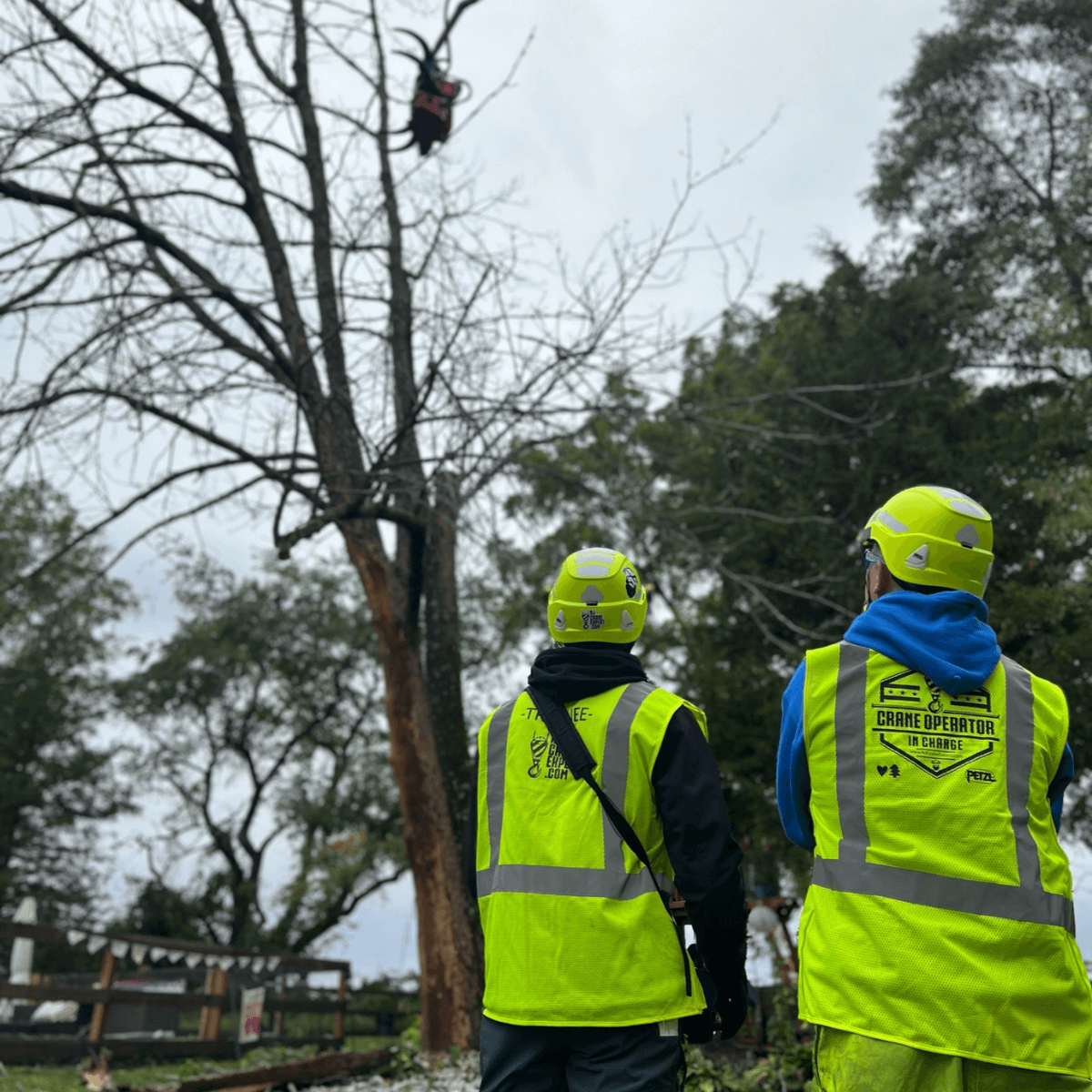
Crane removals are sometimes misunderstood as an expensive luxury. On certain large trees, especially those extending over homes, cranes can be the safest and most controlled option. The crane supports the weight of each cut section before the final cut is made, reducing shock loads and unwanted movement. That can minimize impact on the property and shorten the time workers spend exposed in the tree. But crane work requires precision, a qualified operator, and careful communication between the climber and ground crew. It is not a shortcut. It is a specialized method.
The anatomy of a safe removal
Even when the job looks routine, the sequence is deliberate. Crews usually establish work zones first. Equipment is staged. Escape routes are kept clear. Lowering ropes, rigging blocks, slings, and saws are organized before the dismantling starts. The person cutting and the people on the ground have to understand the same plan.
Most large removals follow a basic logic. The canopy is reduced first to remove weight and create space. Then larger limbs come off in controlled sections. Only after the crown is manageable does the crew begin taking the trunk down in blocks. The stump remains until the upper structure is gone.
Here is the type of preparation professionals typically complete before making the first major cut:
Inspect the tree for decay, cracks, deadwood, lean, and compromised anchor points. Define the work zone, including no entry areas for residents, pets, and vehicles. Choose the access method, whether climbing, bucket, crane, or a combination. Set rigging and communication protocols so every cut has a clear lowering plan. Confirm weather and wind conditions remain within safe working limits.That list looks simple on paper. The judgment inside each step is not simple at all. For example, a rigging point cannot be chosen based only on convenience. It must be strong enough for expected loads, positioned to guide pieces clear of obstacles, and compatible with the direction of pull. One poor anchor point can turn a controlled lowering operation into a violent failure.
Rigging is where skill becomes visible
If you watch a professional crew remove a large tree without damaging a roof, a fence, or a flower bed, you are watching rigging skill at work. The cuts matter, but rigging is what controls the result.
Ropes, pulleys, friction devices, slings, and rigging blocks allow sections of the tree to be supported, redirected, and lowered gradually. Ground workers manage tension and speed while the cutter separates the wood. In skilled hands, a heavy branch can be swung into a narrow landing zone with surprising finesse.
This is also where inexperience shows immediately. Poor rigging creates shock loads that can snap ropes, rip hardware free, or split the remaining wood. Sections can swing into siding or drop faster than expected. Professionals calculate weight by eye constantly. They estimate length, diameter, species density, and moisture content. They cut smaller when the wood is heavier than it looks, when the landing area is tight, or when the rigging angle is less forgiving.
There is a common misconception that a stronger rope solves every problem. It does not. The entire system has to be balanced, from the anchor point to the friction control to the workers on the line. A rope can be rated far beyond the weight of the piece and still be part of a dangerous setup if the dynamic forces are wrong.
Chainsaw work in the canopy is only part of the picture
Homeowners naturally focus on the saw because it is the loudest and most visible tool on site. Yet large tree removal is not just about cutting fast. It is about cutting predictably.
Different cuts serve different purposes. Some are intended to release weight gradually. Others create a hinge to guide movement. In dismantling, the cutter may use holding wood deliberately so a section stays attached until the rope system takes the load. On a spar, meaning the stripped trunk after the limbs are removed, blocking down the wood requires understanding how each cut affects balance, rebound, and landing force.
Good cutters work calmly. They do not rush through compression wood or storm damaged fibers. They pay attention to how the kerf opens and closes. They listen. Wood often gives clues. A section under tension sounds different. A stem with internal decay cuts differently than solid wood. That kind of awareness comes from repetition and respect for the material, not bravado.
Weather changes the entire job
Metairie crews keep a close eye on weather because conditions can shift quickly, especially in storm season. Wind is the obvious factor, but it is not the only one. Gusts can move a suspended section unpredictably. Wet bark affects footing. Rain changes visibility and tool handling. Saturated soil can make trees less stable and limit where equipment can be placed.
Heat matters too. Large removals are physically demanding. Fatigue leads to sloppy communication and slower reactions. On hot, humid days, professional crews pace the work, rotate tasks when needed, and keep hydration practical rather than theoretical. A removal that should take most of the day can become more dangerous late in the afternoon if the team is exhausted and trying to push through the final trunk sections.
There are times when the safest call is to stop and return. That can frustrate homeowners who want the tree gone immediately, especially after a storm. But experienced operators know that the tree is not the only risk. A removal done in poor wind or unstable weather can easily create more damage than the tree itself.
Emergency removals are a category of their own
Not every large tree removal is planned weeks in advance. Storm damaged trees often present a layered problem. One part may already be on the roof. Another limb may be broken but suspended. The trunk may be split yet still standing. In that situation, the first objective is not speed. It is stabilization.
Emergency work often starts with identifying what is loaded and what is loose. A branch pinned against a structure can shift violently when pressure is released. A partially uprooted tree may settle further as weight is removed from the crown. Utility involvement can complicate everything. If lines are affected, tree crews may have to coordinate with the utility before portions of the tree can be touched at all.
The pace of emergency work can look slow to an untrained eye, especially at first. That slow start is usually a good sign. It means the crew is reading the failure pattern before acting.
What homeowners should expect from a reputable crew
A professional tree company does more than show up with saws and a chipper. The job should feel organized from the first site visit through cleanup. Communication should be specific. If a company cannot explain how they plan to remove a large tree in a constrained area, that is a warning sign.
A few markers separate practiced crews from risky ones:
They discuss access, property protection, debris handling, and backup plans if the primary method changes. They identify hazards clearly, including decay, utilities, roof exposure, and restricted drop zones. They explain whether the tree will be climbed, lifted by crane, or accessed by bucket, and why. They set realistic expectations for lawn impact, noise, duration, and what cleanup includes. They do not dismiss concerns with vague reassurance or a promise to “just drop it.”One detail homeowners often appreciate is honest discussion about collateral impact. Even the best tree removal metairie crews cannot always guarantee a pristine lawn if a massive oak must be dismantled during a wet week. What they can do is use mats, minimize equipment passes, choose lighter methods when possible, and tell you upfront what the trade offs are.
The cleanup phase is part of the safety plan
Cleanup is not an afterthought. It is part of how professionals keep the site controlled. Brush left scattered around ropes and saws creates trip hazards. Uncut rounds in the wrong place can roll. Sawdust can hide uneven ground. A disciplined crew processes debris continuously so the work area stays manageable.
Chipping usually happens in parallel with removal when access allows. Brush is fed steadily rather than piled endlessly. Wood may be cut into haulable lengths or left for firewood if the homeowner wants it and the species is suitable. Stump grinding, if included, is usually a separate phase because it requires different equipment and site protection.
This is also when property care becomes visible. Good crews rake, blow, and clear surfaces thoroughly. Great crews notice the gate they unlatched, the irrigation head near the stump, or the rut beginning to form near the truck and address it before leaving.
Why large tree removal is rarely a DIY job
People sometimes ask whether renting a chainsaw and cutting down a troublesome tree is realistic. For a small tree in an open field, maybe. For a large tree near a house in Metairie, the answer is usually no.
The issue is not just height. It is uncertainty. Trees fail in ways that surprise people who work with wood in other contexts. A carpenter can be highly skilled and still be out of depth in a rigged tree removal. The forces are different. The work position is different. The consequence of one incorrect assumption is often severe property damage or life changing injury.
I have seen jobs where the visible problem was a leaning trunk, but the real danger was a cracked union thirty feet up. I have seen a section that looked manageable from the ground prove far too heavy once cut free. I have seen yards with plenty of apparent room reveal hidden constraints the moment the first limb needed to swing past a roof corner. Those are not failures of effort. They are examples of why experience matters.
The real value of professional judgment
When homeowners hire a crew for a large removal, they are paying for labor and equipment, but the deeper value is judgment. They are paying for the ability to see risk before it becomes damage. They are paying for the discipline to take the tree apart in the right order. They are paying for a team that knows when a crane is justified, when a climber should come down, when the wind is too much, and when the cut should be smaller even if it takes longer.
That judgment is what turns a dangerous tree into an orderly project.
In Metairie, where mature trees add beauty and shade but often grow close to the structures people care about most, safe removal depends on that professionalism. The best crews make difficult work look controlled because they have already done the hard part in their heads before the first saw ever starts.
A Perfect Cut Tree Service
4725 Shores Dr, Metairie, LA 70006
+1 504-732-0779
FAQ About tree removal metairie
What is the average cost of tree removal in my area?
There is no single price that fits every tree. Size, condition, access, nearby structures, equipment, debris hauling and stump work affect the estimate. Request a written, site-specific quote that identifies what is included.
Who will remove trees for free?
Free removal is not generally available for ordinary private-property tree work. Utilities or public agencies may handle trees within their responsibilities. Confirm eligibility directly and do not assume that an offer or assistance program covers your tree.
Can I just cut down a tree in my yard?
Check ownership, location and local requirements first. Jefferson Parish requires a permit for removal of qualifying vegetation in the public right-of-way, and additional protections may apply in designated areas. Ask the parish about your property and have a qualified tree professional assess the work.